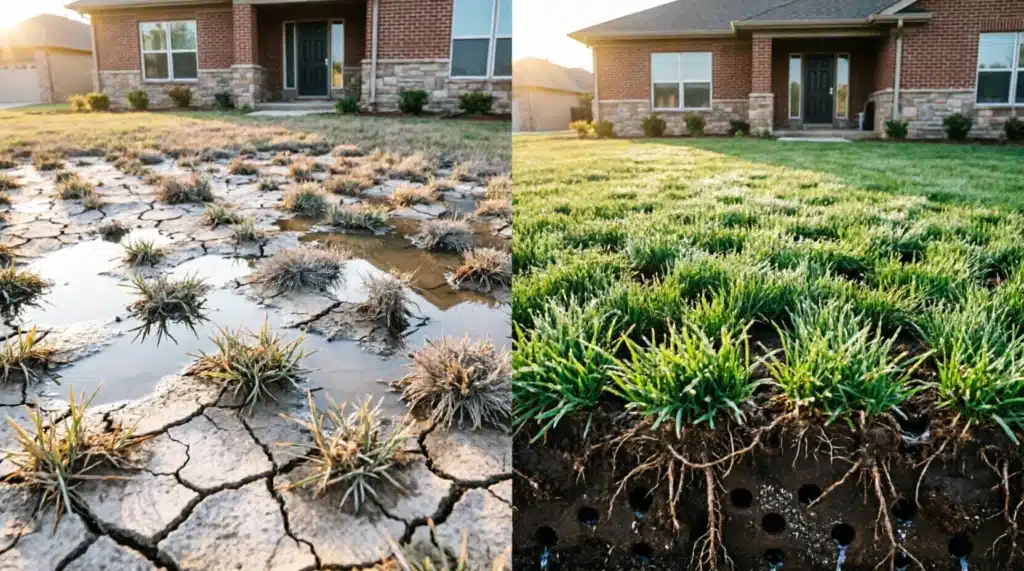
If your lawn looks thin, patchy, or struggles to recover after heavy rains, the problem might not be your fertilizer or your watering schedule.
The culprit could be right beneath your feet.
In Southeast Texas, the ground is notoriously unforgiving, and professional lawn aeration in Houston is often the secret ingredient that separates a struggling lawn from a neighborhood showstopper.
Why is it so difficult to grow grass in Houston soil?
The primary challenge for local homeowners is the high clay content in our soil. Often referred to as “Houston Black Clay,” this earth is incredibly dense.
Over time, walking on the grass, mowing, and even heavy rainfall pack these clay particles tightly together, a process known as soil compaction.
When soil is compacted, it acts like a brick. The roots of your grass can’t penetrate deep into the ground, and essential nutrients can’t reach them. Aeration involves pulling small plugs or cores out of the ground to break up this density, allowing your yard to breathe again as part of your regular yard maintenance in Houston.
Can aeration help my yard survive a Houston summer?
Absolutely. In the peak of summer, the heat can bake our clay soil until it cracks. If your lawn is compacted, any water you apply will simply sit on the surface and evaporate or run off into the street before it ever reaches the roots.
By scheduling lawn aeration in Houston before the hottest months hit, you create direct channels for water to reach the root zone. This encourages your grass to grow deeper, stronger roots. A deeper root system is a more drought-resistant root system, meaning your lawn stays greener longer even when the temperatures climb into the triple digits.
Does aeration help with drainage issues after a storm?
We all know that Houston is prone to sudden, heavy downpours. If your lawn feels like a sponge for days after a storm, or if you see standing water in flat areas, your soil is likely too dense to absorb the moisture.
Aeration improves the “percolation” of your soil. By creating thousands of small holes, you provide a place for that rainwater to go. Instead of sitting on the surface and drowning your grass or attracting mosquitos, the water filters down into the subsoil, nourishing your landscape and drying out the surface much faster.
When is the best time for aeration in Texas?
Timing is everything. For common warm season grasses, the best time to aerate is during the late spring or early summer. That’s when the grass is in its most active growing phase, allowing it to fill in the plug holes and take full advantage of the access to oxygen and nutrients.
Think your soil might be suffocating your grass?
If you want a thicker, greener lawn, reach out! Aeration is a simple, highly effective way to revitalize your property from the roots up. Contact us today!